
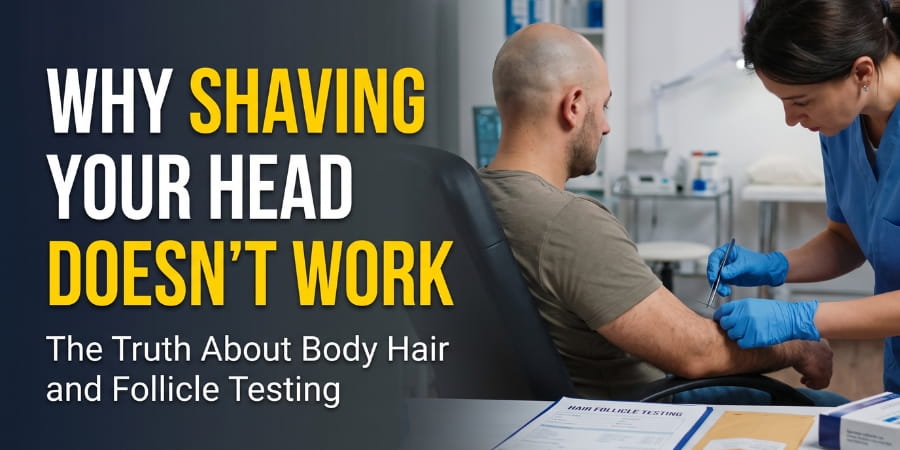
When individuals face an upcoming hair follicle drug screening under high-stress conditions, panic often sets in. Because hair follicle tests possess a wide-angle detection window that can uncover a substance history extending back up to 90 days or more, people frequently search for shortcuts or quick fixes. Among the most pervasive and dangerous myths circulating on internet forums and social media is the belief that shaving your head completely bald will allow you to bypass the test entirely.
The flawed logic behind this myth assumes that if there is no hair on the scalp, the testing facility cannot collect a specimen, rendering the screening impossible. However, this physical evasion strategy is entirely ineffective. It stems from a profound misunderstanding of modern toxicology, laboratory chain-of-custody protocols, and human biology.
This comprehensive guide explores the absolute truth about body hair collection, laboratory protocols, and why attempting to outsmart a hair test through physical removal is a futile endeavor.
The Core Misconception: The “Clean Slate” Illusion
To understand why shaving your head fails, you must first examine how drug metabolites become embedded in your hair in the first place. When a substance is consumed, it enters the bloodstream. As blood circulates throughout the body, blood vessels surrounding the hair follicles nourish the growing hair strands. During this biological process, drug metabolites pass from the blood into the growing cells, where they become permanently locked deep inside the hard protein matrix known as the keratin cortex.
When someone shaves their head right before a scheduled test, they are only removing the existing hair shaft above the surface of the skin. They are not altering the systemic metabolic history recorded throughout the rest of their body’s tissues. More importantly, testing laboratories and collection administrators are fully aware of this tactic. Shaving your head does not erase your history; it merely signals to the collection staff that an evasion attempt may be underway.
How Collectors Handle Missing Scalp Hair: The Reality of Body Hair Collection
If an individual arrives at a collection site with a shaved head, buzzing close to the skin, or insufficient scalp hair to meet standard testing lengths (typically requiring a 1.5-inch sample cut close to the root), the technician does not simply cancel the test. Instead, they immediately transition to standard alternative protocols.
Under professional laboratory chain-of-custody procedures, testing facilities are fully authorized to harvest hair from alternative regions of the body. Collectors can easily collect valid hair samples from:
· The Chest
· The Arms
· The Legs
· The Back
Because body hair is completely acceptable under standard laboratory guidelines, shaving your head does nothing to prevent specimen collection. In fact, some individuals who attempt to shave their body hair as well find themselves facing even stricter scrutiny or alternative testing matrices.
Suspicion, Red Flags, and Alternative Testing Options
Arriving at a clinical collection site with a completely shaved head or unusual hair removal immediately alerts the collection technician to potential tampering or evasion. Testing administrators deal with these scenarios routinely.
When a subject presents no usable scalp hair, the situation often escalates beyond a simple hair collection:
· Immediate Suspicion: Technicians recognize that voluntary hair removal is rarely coincidental, especially when mandated by employers or legal entities.
· Pivoting to Alternative Screens: If head and body hair collection is compromised or deemed insufficient, testing facilities may offer or require the subject to submit to alternative evaluation methods, such as an immediate supervised urine drug test or a blood test.
· Refusal Classifications: In certain corporate, legal, or Department of Transportation (DOT) regulated environments, intentionally altering your physical appearance or destroying specimens to avoid a test can be legally classified as a “refusal to test,” carrying the exact same legal and professional consequences as a verified positive laboratory result.
Scalp Hair vs. Body Hair: Growth Rates and Detection Timelines
While body hair solves the collection requirement for the laboratory, it introduces unique biological characteristics that make it an even broader indicator of substance history:
· Scalp Hair Growth Rate: Scalp hair grows at a remarkably steady, predictable rate of approximately 0.5 inches per month, which is why a standard 1.5-inch sample maps out a precise 90-day window.
· Body Hair Growth Dynamics: Body hair grows significantly slower and follows a complex cycle involving growth, resting, and shedding phases. Because body hair does not grow continuously like head hair, a body hair sample does not reflect a clean 90-day timeline. Instead, body hair can capture a much wider, blended historical window that often spans several months or even up to a year.
Why Physical Evasion Fails vs. Structured Preparation
Attempting to bypass a high-stakes hair follicle test through physical alterations like head shaving, bleaching on its own, or using unverified home remedies is a high-risk gamble that almost always backfires. Modern testing laboratories utilize ultra-sensitive confirmatory instrumentation—such as Gas Chromatography-Tandem Mass Spectrometry (GC-MS/MS) and Liquid Chromatography-Tandem Mass Spectrometry (LC-MS/MS)—to analyze whatever keratin matrix is available.
For individuals facing a strict screening, physical evasion creates immediate red flags and secondary problems. The only reliable path to managing hair test preparation is understanding the science, avoiding unverified myths, and utilizing structured, purpose-formulated professional protocols—such as authentic Macujo Aloe Rid® Shampoo paired with the complete 9-step Mike’s Macujo Method.