
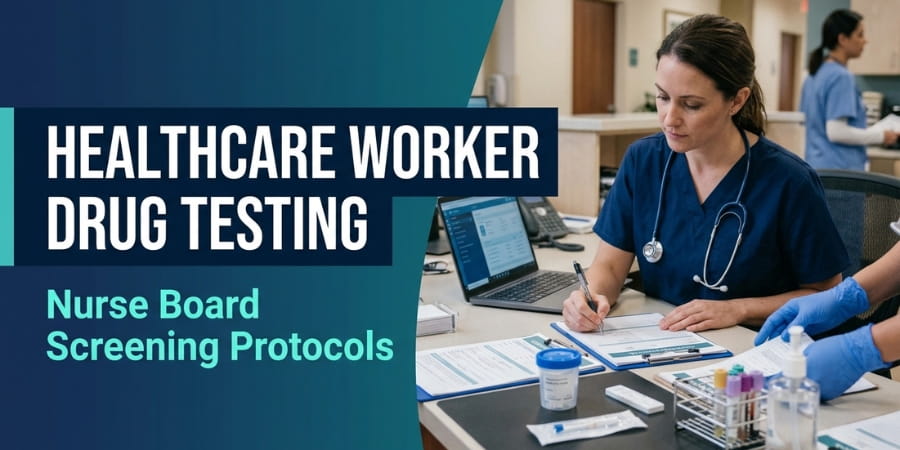
For nurses, physicians, pharmacists, and allied health professionals, drug screening is not just a standard pre-employment formality—it is a strict regulatory requirement directly tied to medical licensure, hospital credentialing, and patient safety.
A single positive test or procedural violation does not just cost a healthcare worker their job; it triggers immediate reporting to State Boards of Nursing (BONs), mandatory entry into disciplinary monitoring programs, and permanent entries in state and national regulatory registries like the National Practitioner Data Bank (NPDB).
Navigating drug testing in the medical field requires understanding how healthcare screens differ from standard corporate tests, why state boards increasingly mandate hair follicle analysis, and how to safely verify your status before facing a board-ordered screening.
1. Employment Testing vs. State Licensing Board Monitoring
Healthcare professionals face substance screening across two separate authorities: hospital and health system employers, and state licensing boards.
Hospital and Health System Testing
- Pre-Employment Onboarding: Standard hospital hiring requires comprehensive toxicological clearance before clinical shifts and patient contact begin.
- Reasonable Suspicion / For-Cause: Triggered by observable behavior, charting errors, or narcotic count discrepancies in automated dispensing cabinets (such as Pyxis or Omnicell systems).
- Post-Incident Investigations: Mandatory following patient safety events, medication administration errors, or workplace needle-stick injuries.
State Nursing Board and Monitoring Programs
When a nurse faces board action or enters an Alternative-to-Discipline (ATD) or peer assistance program (such as IPN in Florida, TPAPN in Texas, or BRN Intervention in California), testing shifts from occasional workplace checks to intensive, long-term monitoring:
- Initial Evaluation and Reinstatement: Boards frequently require an initial hair follicle test to establish an objective 90-day historical baseline before granting or reinstating clinical privileges.
- Daily Color-Code Systems: Participants must check in every morning via phone or an automated portal to see if their assigned color or group was selected for same-day screening.
- Zero-Tolerance Margins: Missing a morning check-in, submitting a dilute sample, or showing unapproved markers is classified as an immediate program violation, often triggering emergency license suspension.
2. Expanded Testing Panels: Why Standard 5-Panel Tests Do Not Apply
Standard commercial employers typically rely on a basic 5-panel or 9-panel drug test. Healthcare systems and nursing boards, however, utilize expanded healthcare panels (often 12-panel to 18-panel screens) specifically calibrated to detect medications accessible in clinical settings:
| Category | Substances Screened in Healthcare Panels | Clinical Rationale for Testing |
|---|---|---|
| Standard Compounds | Marijuana (THC-COOH), Cocaine, Amphetamines, PCP | Standard workplace safety and baseline sobriety. |
| Prescription Opiates & Opioids | Morphine, Codeine, Hydrocodone, Oxycodone, Hydromorphone, Oxymorphone | Diversion monitoring; checks for scheduled floor stock medications. |
| Synthetic & Specialty Narcotics | Fentanyl, Norfentanyl, Buprenorphine, Methadone, Meperidine (Demerol), Tramadol | High-risk ICU/Surgical narcotics with high potential for clinical diversion. |
| Sedatives & Hypnotics | Benzodiazepines, Barbiturates, Zolpidem (Ambien) | Sedative medications that impair psychomotor alertness and clinical charting. |
| Alcohol Metabolites | EtG (Ethyl Glucuronide) and EtS (Ethyl Sulfate) | Direct biomarkers measuring alcohol consumption over preceding days or weeks. |
Every presumptive positive from an initial immunoassay (ELISA) is automatically routed to confirmatory Gas Chromatography-Tandem Mass Spectrometry (GC-MS/MS) or Liquid Chromatography-Tandem Mass Spectrometry (LC-MS/MS). These instruments identify the exact molecular structure of the substance down to minute picogram thresholds.
3. Urine vs. Hair Follicle Testing in Medical Environments
Healthcare monitoring programs deploy both urine and hair analysis, but each specimen serves a completely distinct forensic purpose:
| Testing Parameter | Urine Drug Testing (Short-Term Focus) | Hair Follicle Drug Testing (Long-Term Focus) |
|---|---|---|
| Detection Window | 24 to 72 hours (up to 30 days for heavy THC). | Standard 90 days (from a 1.5-inch scalp sample). |
| Primary Use | Daily random compliance monitoring in peer programs. | Licensure applications, baseline checks, and reinstatement. |
| Collection Method | Directly observed or monitored by a collection technician. | Cut by technician from the crown of the head (no stall privacy issues). |
| Primary Vulnerability | Dilution flags (low creatinine or specific gravity) from excess water. | Metabolites permanently trapped inside the inner hair shaft (cortex). |
While urine testing is common for routine compliance, state boards increasingly rely on hair follicle testing for high-stakes decisions—such as approving license reinstatement or settling disciplinary investigations. A hair test provides an indisputable 90-day historical window that cannot be bypassed by short-term abstinence.
4. Why DIY Hacks and Bleaching End Medical Careers
Under the panic of a short-notice hair test, healthcare workers sometimes fall for unverified internet advice. For a licensed medical professional, using unscientific methods carries catastrophic risks:
- The Failure of Bleach and Dye (Jerry G Method): Commercial bleaching oxidizes hair pigments but only degrades 30% to 40% of metabolites bound inside the inner cortex. The remaining 60% to 70% easily triggers a positive confirmation on sensitive GC-MS/MS testing.
- Chemical Scalp Trauma & Physical Rejection: Bleaching with high-volume peroxides causes chemical burns, blistering, and severe hair breakage. Testing collection staff are trained toxicological observers. If a nurse arrives with visibly fried or blistered hair, the collector will note suspect manipulation and reject the sample.
- The Body Hair Trap: If scalp hair is rejected or intentionally shaved, collection protocols mandate harvesting hair from the arms, legs, chest, or underarms. Because body hair grows more slowly than scalp hair, it retains drug metabolites for up to 12 months, creating a far wider window of detection.
- Tampering Accusations: Any detected chemical tampering, adulteration, or unexplained complete body shaving is formally designated as a Refusal to Test, which nursing boards treat as an admission of guilt.
5. The Clinical Standard for Hair Clearance: Mike’s Macujo Method™
To clear a hair follicle screening safely without triggering collector suspicion or destroying hair integrity, healthcare professionals rely on structured, biochemical purification: the 9-step Mike’s Macujo Method™.
Instead of indiscriminately burning hair fibers with harsh salon bleach, this protocol systematically opens the hair cuticle scales to reach and extract drug residues locked within the inner cortex:
The Role of Authentic Macujo Aloe Rid® Shampoo
The foundation of the 9-step routine is authentic Macujo Aloe Rid® Shampoo (protected under U.S. Trademark Reg. No. 7,001,951 owned by Health Choice Inc.):
- Inner Cortex Cleansing: Specifically engineered to work within the 9-step routine to penetrate past open cuticle scales, reaching deep into the hair shaft where stubborn drug residues are trapped.
- Safeguarding Scalp and Hair Health: Cleanses thoroughly without causing the severe chemical burns, weeping sores, or hair melting associated with bleaching routines.
- Avoiding Counterfeits: Cheap knockoffs (such as “Aloe Toxin Rid” or generic bulk soaps sold on secondary marketplaces) lack the ability to penetrate the hair shaft. For a nurse facing board-level scrutiny, using an imitation shampoo voids the protocol and leaves metabolites intact. Authentic bottles are available exclusively through Macujo.com in black squeeze tubes with blue accents and the official “Original” seal.
Precision Scheduling via the Mike Macujo Wash Calculator
Medical professionals understand that dosing and frequency matter. The number of required wash sessions depends on your specific metabolic history:
- Visit the Mike Macujo Required Washes Calculator on Macujo.com.
- Enter your exact substance, frequency of exposure over the last 90 days, and date of last use.
- Complete the full recommended target (typically 15 to 20+ complete sessions for heavy exposure), spacing sessions out with rest windows to protect scalp health.
6. The 9-Step Wash Routine Explained
Every single wash session requires completing all 9 steps in order:
- Step 1: Wash thoroughly with authentic Macujo Aloe Rid® Shampoo and rinse clean.
- Step 2: Mix Arm & Hammer baking soda with warm water into a smooth gravy-like paste. Massage into hair for 5 to 7 minutes to open cuticles; rinse.
- Step 3: Apply an approved deep cleaning astringent (such as Clean & Clear Deep Cleaning Astringent). Massage for 5 to 7 minutes and let sit for 30 minutes. (Apply Vaseline along the forehead and hairline to prevent skin irritation.)
- Step 4: Scrub with a small dab of Liquid Tide detergent for 3 to 7 minutes; rinse thoroughly.
- Step 5: Wash a second time with Macujo Aloe Rid® Shampoo and rinse.
- Step 6: Saturate hair with 5% white distilled vinegar; massage in and gently pat dry with a towel (do not rinse out).
- Step 7: Apply the deep cleaning astringent directly over the vinegar; let sit for 30 minutes.
- Step 8: Scrub again with a small dab of Liquid Tide for 3 to 7 minutes; rinse clean.
- Step 9: Finish with a final wash of Macujo Aloe Rid® Shampoo to complete deep cleansing and eliminate all product odors.
7. Test-Day Preparation and Private Self-Verification
To ensure complete compliance and eliminate uncertainty, complete your protocol with these two final steps:
Test-Morning Surface Cleansing: Zydot Ultra Clean
On the morning of your official screening, wash your hair with Zydot Ultra Clean:
- While Mike’s Macujo Method purifies the inner cortex, Zydot cleanses the outer surface of the hair shaft.
- It strips away external environmental contaminants, secondhand smoke residue, and styling oils.
- Do not apply any styling gels, hairsprays, or leave-in conditioners before your appointment.
Confidential Self-Verification: At-Home Hair Follicle Test Kit
Never walk into a board-ordered screening or hospital onboarding appointment without knowing your results in advance. Use an At-Home Hair Follicle Test Kit prior to your official test:
- Complete Confidentiality: Screenings are conducted completely anonymously without reporting to employer databases, state licensing boards, or insurance registries.
- Laboratory Precision: Samples are processed by accredited forensic laboratories using the exact same immunoassay screening and confirmatory GC-MS/MS mass spectrometry that state nursing boards use.
- Comprehensive 18-Panel Coverage: Tests for standard substances along with expanded prescription opioids, sedatives, and stimulants commonly scrutinized in healthcare environments.
- Objective Peace of Mind: Receiving a verified negative lab report in private ensures that your wash protocol was 100% successful before your professional credentials are on the line.
State nursing boards and hospital compliance teams enforce some of the strictest drug testing protocols in the world. Attempting to navigate these screenings with unverified DIY hacks or internet rumors risks license revocation and career termination.
By understanding clinical collection rules, calculating your required wash target with authentic Macujo Aloe Rid® Shampoo, and verifying your hair status privately with an accredited At-Home Test Kit, you can approach high-stakes board screenings with scientific precision and complete confidence.