
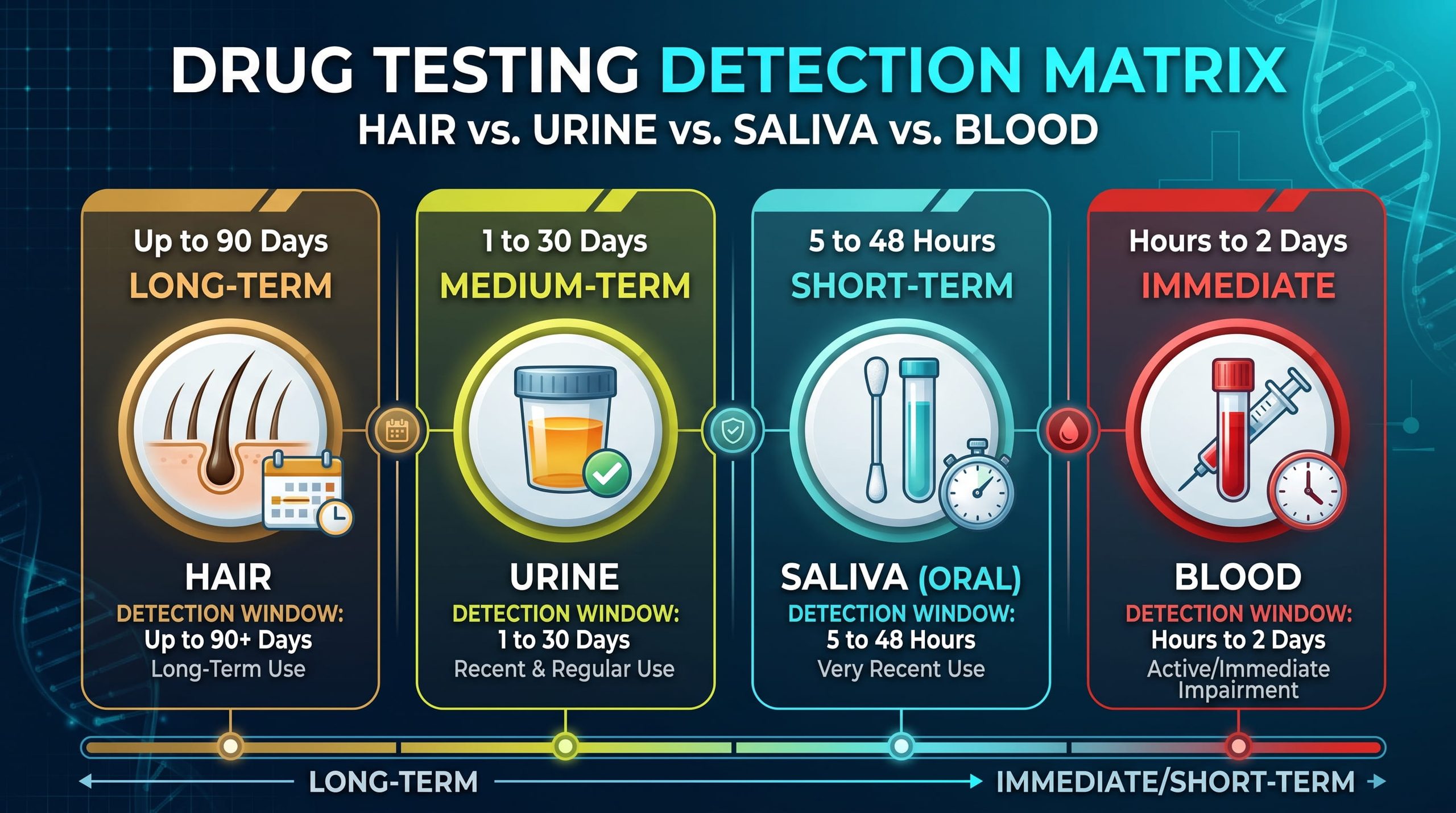
When navigating drug screening requirements—whether for employment onboarding, legal compliance, athletic monitoring, or personal peace of mind—understanding the fundamental operational mechanics of different testing methods is critical. Not all drug tests are created equal. Each testing modality targets distinct biological specimens, utilizes unique cutoff thresholds, operates under specialized laboratory techniques, and possesses vastly different detection windows.
For employers designing compliance policies or individuals trying to understand their exposure risks, relying on generic assumptions can lead to costly mistakes. This master comparison guide charts the exact detection windows, physiological mechanisms, cutoff levels, and testing sensitivities across all four major drug screening types: Hair, Urine, Saliva, and Blood.
1. Hair Follicle Testing: The Long-Term Historical Record
Hair follicle testing is widely recognized as the gold standard for organizations demanding strict, long-term historical accountability. Unlike fluid tests that capture recent usage, hair testing provides a wide-angle lens into an individual’s substance history over an extended period.
Biological Mechanism & Growth Rate
When a substance is ingested, it enters the bloodstream. Blood vessels surrounding the hair follicles nourish the growing hair strand, transferring drug molecules and their metabolic byproducts directly into the biological matrix. As the hair grows outward from the scalp, these metabolites become permanently trapped deep inside the hard protein structure known as the keratin cortex.
Human scalp hair grows at a remarkably consistent average rate of approximately 0.5 inches (1.27 centimeters) per month. Because standard laboratory collection protocols require a 1.5-inch hair sample cut close to the scalp, a standard hair test establishes a reliable 90-day historical window.
Detection Window, Cutoffs, and Sensitivities
- Standard Detection Window: Up to 90 days (based on a 1.5-inch sample). Body hair samples can extend this window significantly (up to 12 months), though body hair growth rates and metabolic retention vary unpredictably.
- Cutoff Levels & Sensitivities: Measured in picograms per milligram (pg/mg). Hair testing utilizes ultra-sensitive confirmation methods like Gas Chromatography-Tandem Mass Spectrometry (GC-MS/MS) or Liquid Chromatography-Tandem Mass Spectrometry (LC-MS/MS) to isolate metabolites from external environmental contamination.
- Primary Target Specimen: Keratinized hair shaft protein.
2. Urine Testing (Urinalysis): The Workplace Standard
Urinalysis is by far the most widespread evaluation method utilized across corporate America, government agencies, sports leagues, and clinical institutions. It strikes a balance between cost-efficiency, administrative ease, and a moderate detection window.
Biological Mechanism & Filtration
When the body processes chemical substances, the liver breaks them down into water-soluble byproducts called metabolites. These metabolites are filtered out of the bloodstream by the kidneys and stored in the bladder before excretion. Because urine collects waste products over time, it reflects a cumulative history of use rather than immediate impairment.
Detection Window, Cutoffs, and Sensitivities
Detection timelines in urine vary dramatically depending on the substance involved and the frequency of historical use.
- Alcohol (EtG Tests): Ethyl Glucuronide metabolites can be detected in urine for up to 3 to 4 days after heavy consumption.
- Cannabis (THC): Because THC metabolites are highly fat-soluble (lipophilic), they bind to adipose tissue. For light or infrequent users, THC clears in 1 to 3 days; however, for chronic, heavy daily users, metabolites can remain detectable in urine for 30 days or longer.
- Other Substances (Opiates, Cocaine, Amphetamines, Benzodiazepines): Typically remain detectable for 2 to 4 days.
- Standard Cutoff Levels: Governed strictly by federal and clinical standards. For instance, the initial immunoassay cutoff for THC metabolites is typically set at 50 ng/mL, followed by a GC-MS confirmation cutoff at 15 ng/mL.
3. Saliva Testing (Oral Fluid): The Recent-Use Indicator
Saliva testing—formally known as oral fluid screening—has grown exponentially in popularity due to its extreme convenience, non-invasive collection process, and inability to be adulterated in a traditional restroom setting.
Biological Mechanism & Oral Clearance
Saliva is produced by the salivary glands, which draw substances directly from the blood via passive diffusion. Additionally, smoking, vaping, or oral ingestion deposits residual drug molecules directly onto the mucous membranes of the oral cavity, tongue, and cheeks. Because oral fluids capture active compounds and recent ingestion residues, saliva tests are uniquely designed to identify very recent use or active influence.
Detection Window, Cutoffs, and Sensitivities
- Standard Detection Window: Typically 1 to 72 hours, depending heavily on the specific substance, oral pH, and frequency of use.
- Cannabis (THC): Detectable much faster in saliva than in urine—often appearing within minutes of smoking and clearing within 24 to 36 hours for moderate users.
- Cocaine and Amphetamines: Detectable within 1 to 2 days.
- Cutoffs: Oral fluid tests utilize aggressive low-level thresholds to catch active exposure immediately following ingestion.
4. Blood Testing: The Clinical and Legal Standard
Blood testing represents the most invasive yet scientifically precise evaluation method available. Because blood collection requires trained medical personnel and needle insertion, it is rarely used for routine pre-employment screening. Instead, blood tests are reserved for hospital diagnostics, severe workplace accidents, clinical trials, and DUI/DWI forensic investigations.
Biological Mechanism & Circulation
The bloodstream acts as the body’s primary transport highway. When drugs are introduced, they circulate actively through the cardiovascular system, delivering active compounds directly to the brain and vital organs before being metabolized by the liver and filtered by the kidneys.
Detection Window, Cutoffs, and Sensitivities
- Standard Detection Window: Extremely short—usually 12 to 48 hours. Because the body actively metabolizes and clears substances from the blood rapidly, a blood test measures active intoxication rather than distant historical use.
- Primary Utility: Proving recent impairment or active chemical presence in legal and emergency settings.
Master Comparison Guide: Hair vs. Urine vs. Saliva vs. Blood
5. Decoding Laboratory Standards: Immunoassay vs. Confirmatory Spectrometry
Understanding how labs analyze these specimens explains why preparation strategies must be precise. Virtually all high-volume screening follows a two-tier testing protocol:
- Initial Immunoassay Screening: Fast, cost-effective, and designed to process high volumes. Immunoassays use chemical antibodies that react to specific drug classes. If a sample falls below the cutoff threshold, it is instantly reported as negative. If it triggers a reaction, it is categorized as “non-negative” or presumptive positive.
- Confirmatory Testing (GC-MS / LC-MS): Any presumptive positive sample is automatically retested using Gas or Liquid Chromatography coupled with Mass Spectrometry. This advanced technology shatters molecules apart and maps their precise atomic weight, completely eliminating false positives from legal prescription drugs or dietary cross-reactivity.
Conclusion: Choosing the Right Strategy Based on the Test Type
Navigating a drug screening successfully requires matching your preparation approach to the specific test modality you face:
- Facing a Hair Test requires intensive cuticle-opening protocols and deep cortex cleansing because metabolites are permanently locked inside the keratin protein.
- Facing a Urine Test requires managing hydration balance, supporting natural clearance, or utilizing reliable synthetic substitutes and detox liquids within the correct clearance window.
- Facing a Saliva Test requires neutralizing oral mucosal residues using targeted oral cleansers immediately prior to your screening.
By understanding the precise metrics outlined in this detection matrix, individuals and professionals can approach any screening protocol with absolute clarity and structured preparedness.