
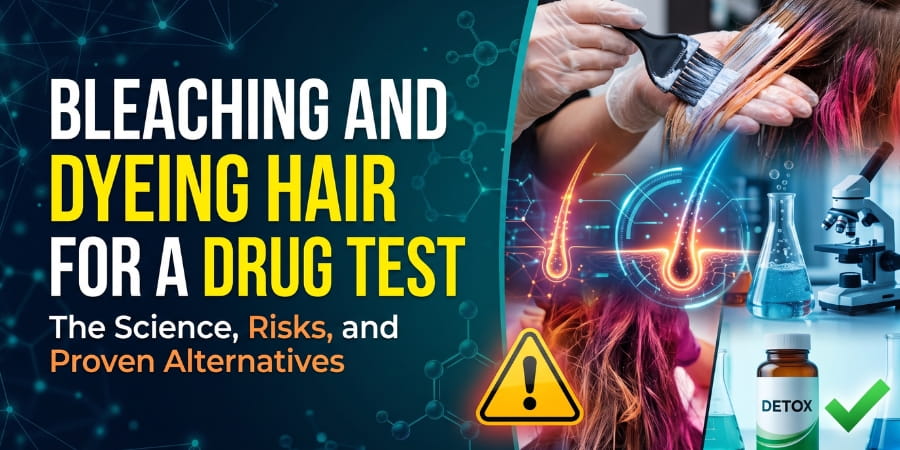
Facing a hair follicle drug test can cause immediate panic, especially when a job, career, or legal situation depends on the result. Because hair tests provide a long look-back window of up to 90 days, many people search online for quick ways to strip their hair. One of the most common DIY hacks discussed on forums is the “Bleach and Dye” method, often called the Jerry G method.
While bleaching changes how your hair looks on the outside, looking at toxicology research shows why this home hack fails laboratory standards. Understanding how hair grows, how testing facilities detect drug traces, and how structured cleansing protocols work will help you make an informed, safe decision.
1. How Hair Follicle Testing Works
To understand why home bleaching rarely works, it helps to look at the biology of hair growth:
- Bloodstream Transfer: When a person consumes any substance—such as marijuana, cocaine, opiates, or prescription medications—the active compounds enter the bloodstream.
- Deposition in the Hair Bulb: Blood vessels feed the roots of hair follicles beneath the scalp, depositing drug breakdown products (known as metabolites) directly into the growing hair strand.
- Trapped Inside the Cortex: As the hair strand grows outward, these drug metabolites become permanently locked inside the cortex—the dense, inner protein core beneath the protective outer layer (cuticle).
- The 90-Day Standard: Collection technicians typically cut a 1.5-inch hair sample directly from the scalp. Since human head hair grows at an average rate of 0.5 inches per month, a 1.5-inch strand provides a reliable 90-day historical record of substance use.
- The Body Hair Factor: If head hair is unavailable or too short, collectors can take hair from the arms, legs, or chest. Because body hair grows at a slower pace than head hair, it can retain drug markers for an even longer period.
2. Hair Anatomy: Cuticles, the Cortex, and Melanin
Hair is not a simple sponge; it is a complex, layered structure made of tough keratin proteins:
- The Cuticle: The outside layer made of overlapping scales that protect the strand.
- The Cortex: The thick inner core that makes up roughly 80% to 90% of the hair’s bulk. The cortex contains melanin pigments (which give hair its color) and holds embedded drug metabolites.
- The Melanin Binding Effect: Research indicates that dark hair contains higher amounts of eumelanin, which binds more tightly to basic drug metabolites like cocaine and amphetamines compared to lighter hair. This means individuals with dark or thick hair often have higher concentrations of trapped metabolites.
3. What Is the Bleach and Dye (Jerry G) Method?
The Jerry G method is an aggressive home routine developed on early internet discussion boards. The process generally involves:
- Stopping all substance use immediately.
- Applying commercial hair bleach to force open the hair cuticles.
- Applying a permanent hair dye with ammonia to recolor the hair back to its natural shade.
- Washing the hair with detox shampoos over several days.
- Re-bleaching and re-dyeing the hair immediately before the scheduled test date.
- Applying a baking soda paste on the day of the test followed by a final shampoo.
4. Why Bleach and Dye Fails in the Laboratory
While bleaching physically alters your hair, laboratory science reveals serious flaws with this approach:
- It Only Removes a Fraction: Scientific evaluations show that bleaching reduces drug metabolite levels by only about 30% to 40%. Leaving 60% to 70% of the metabolites intact means the sample easily remains above positive cutoff thresholds.
- Bleach Does Not Dissolve the Cortex: Household bleach and salon peroxides break down outer melanin pigments to lighten hair, but they do not contain the specialized chelating agents needed to break the chemical bonds holding drug metabolites inside the inner core.
- Labs Wash Every Sample First: Technicians wash all incoming hair samples with specialized lab detergents to remove cosmetic treatments, oils, and dyes before testing. This process strips away surface color, exposing the cortex underneath.
- GC-MS/MS Mass Spectrometry Precision: After an initial screening, labs verify presumptive positives using Gas Chromatography-Tandem Mass Spectrometry (GC-MS/MS) or Liquid Chromatography-Tandem Mass Spectrometry (LC-MS/MS). These advanced instruments measure target compounds down to picograms per milligram (pg/mg). Because bleaching leaves core metabolites in place, mass spectrometers easily detect them.
Standard Laboratory Cutoff Levels
Laboratories use specific cutoff thresholds to confirm positive results:
| Substance | Screening Cutoff (ELISA) | Confirmation Cutoff (GC-MS/MS) |
|---|---|---|
| Marijuana (THC) | 1 pg/mg | 0.1 pg/mg |
| Cocaine | 500 pg/mg | 500 pg/mg (or 300 pg/mg) |
| Opiates | 200 pg/mg | 200 pg/mg (or 500 pg/mg) |
| Methamphetamine | 500 pg/mg | 500 pg/mg (or 300 pg/mg) |
| PCP | 300 pg/mg | 300 pg/mg |
Because confirmation cutoffs are so low, a 30% reduction from bleaching is not enough to get below these strict limits.
5. Scalp and Hair Health Risks of Home Bleaching
Repeated bleaching and ammonia-based dyeing within a few days carries significant physical risks:
- Chemical Burns: High-volume hydrogen peroxide and ammonia can cause severe chemical burns, redness, and blistering on the scalp.
- Permanent Follicle Damage: Chemical irritation can damage hair follicles, leading to uneven hair regrowth or temporary hair loss.
- Severe Breakage: Double-bleaching strips hair of natural proteins and moisture, making hair strands brittle, straw-like, and prone to breaking off at the root.
- Collector Suspicion: Technicians are trained to notice severely damaged or fried hair. If scalp hair appears melted or heavily burned, collectors may reject the head hair and take a body hair sample instead.
6. Debunking Other Common Hair Test Myths
- Myth 1: Shaving Your Head Avoids the Test. Shaving head hair does not prevent a test. Collectors will simply take hair from your chest, arms, legs, or underarms, where drug metabolites stay trapped even longer. Arriving with a completely shaved body can be flagged as a test refusal.
- Myth 2: Regular Clarifying Shampoos Clear Metabolites. Standard clarifying shampoos remove surface oil, styling wax, and dirt, but they cannot penetrate past the outer cuticle to clean the cortex.
- Myth 3: Last-Minute Abstinence Cleans Hair. While stopping drug use is critical, hair tests look back 90 days. Quitting a few days before the test will not clear metabolites that entered your hair weeks or months earlier.
7. Structured Cleansing: The Professional Alternative
Rather than damaging hair with bleach, structured cleansing protocols focus on systematically opening the cuticle, lifting out trapped residues, and protecting the scalp.
- Specialized Penetrating Shampoo: Professional protocols use Macujo Aloe Rid® Shampoo, which is formulated with high concentrations of propylene glycol to penetrate deep into the hair shaft and EDTA to break down and lift embedded metabolites.
- Mike’s Macujo Method™ (9-Step Routine): This comprehensive process systematically opens cuticles and cleanses the cortex using a precise sequence: an initial wash with Macujo Aloe Rid® Shampoo, an Arm & Hammer baking soda paste scrub, a 2% salicylic acid astringent (such as Clean & Clear), an abrasive Liquid Tide scrub, a second shampoo wash, a white vinegar soak, a second astringent application, a second Tide scrub, and a final wash with Macujo Aloe Rid® Shampoo.
- Personalized Washing Schedules: One wash is never enough for everyone. The online Mike Macujo Required Washes Calculator estimates the exact number of cleansing sessions needed based on the substance used, frequency of use, and the date of last exposure.
- Test-Day Surface Purifying: Using Zydot Ultra Clean on the morning of the screening provides a final external stripping wash to eliminate any surface buildup or environmental contamination.
- Pre-Test Verification: Using an At-Home Hair Follicle Test Kit (which screens for up to 18 drugs using accredited laboratory GC-MS/MS testing) allows you to check your status privately before your official appointment.
Comparison of Common Approaches
| Parameter | Bleach & Dye (Jerry G Method) | Mike’s Macujo Method™ | Natural Abstinence Alone |
|---|---|---|---|
| How It Works | Burns cuticle with bleach and recolors with dye. | Systematically opens cuticle and cleanses cortex. | Waits for hair to naturally grow and shed. |
| Metabolite Reduction | Roughly 30% to 40% reduction. | Designed to clear residues below lab cutoffs. | Zero reduction in existing hair growth. |
| Impact on Hair Health | Causes severe hair frying, breakage, and chemical burns. | Protects hair structure using controlled, gradual sessions. | No hair damage. |
| Laboratories Evaluation | Readily detected by GC-MS/MS mass spectrometry. | Formulated to meet strict GC-MS/MS standards. | Passes only after 90+ days of clean hair growth. |
| Personalization | Generic guess from forum posts. | Customized using the Mike Macujo Wash Calculator. | Fixed calendar timeline. |
Making an Informed Decision for Your Hair Test
Hair follicle testing is designed to detect long-term substance use by measuring drug metabolites locked inside the inner cortex. Relying on aggressive home remedies like the Jerry G bleach-and-dye hack causes severe scalp trauma and hair breakage while leaving up to 70% of the drug markers behind for lab mass spectrometers to find.
For reliable preparation, focus on verified toxicology facts. Cease all substance use immediately, determine your required washing sessions using the official calculator, use authentic Macujo Aloe Rid® Shampoo within Mike’s Macujo Method™, finish with Zydot Ultra Clean, and verify your results with an at-home hair screening kit to approach your test with confidence.