
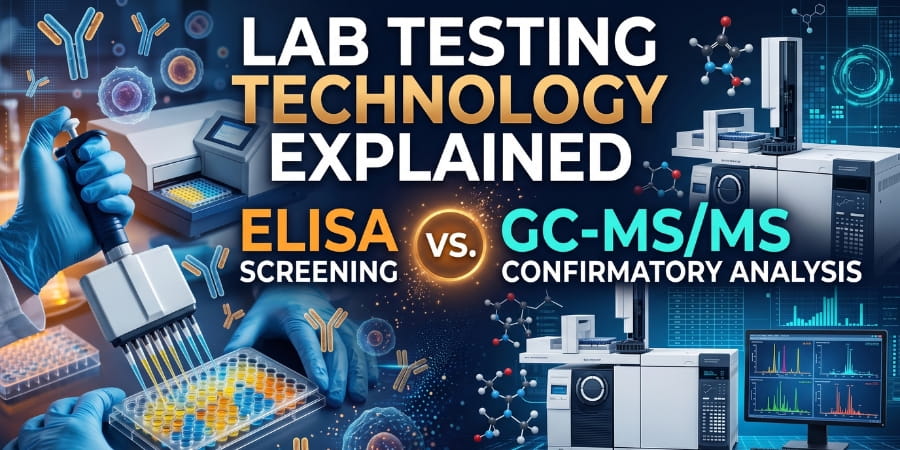
When you submit a sample—whether it is urine, oral fluid, or hair—for a drug test, it goes through a careful process inside a professional laboratory. Many people think a lab technician just drops a chemical liquid into a vial and instantly gets a final positive or negative answer. In real life, professional testing follows a strict two-step process to make sure the results are completely accurate and fair.
Understanding how this two-step process works explains why a quick initial test might sometimes show a “non-negative” alert, and how advanced lab equipment checks the real facts.
The Two-Step Testing Protocol: Why Accuracy Matters
Because employment, legal cases, and career futures depend on these test results, labs cannot rely on just one quick check. They use a two-step system to prevent any mistakes:
- Step 1: High-Speed Screening (Immunoassays / ELISA): Used to test large numbers of samples quickly and cheaply to filter out clean samples.
- Step 2: Confirmatory Testing (GC-MS/MS or LC-MS/MS): Used only when a sample shows a potential positive result, checking the exact chemical makeup with zero room for error.
Step 1: Initial Immunoassay Screening (ELISA)
The first line of defense in any lab is an immunoassay, usually done using ELISA (Enzyme-Linked Immunosorbent Assay) technology.
How ELISA Works
ELISA uses a biological matching process between antibodies and drug traces:
- Antibodies: Labs create special antibodies designed to lock onto specific drug breakdown products (called metabolites), such as THC, cocaine, or opiates.
- The Competition: Enzyme-tagged drug molecules are added to the sample. They compete with any actual drugs present in your sample to attach to the antibodies.
- The Color Change: If a lot of drugs are present, they fill up the antibody spots, leaving the tagged molecules free. A chemical is added to trigger a color change, which a machine reads to see if the sample passes the established cutoff limit.
Pros and Cons of ELISA
- Pros: Extremely fast, highly sensitive, and cheap enough to test many samples at once.
- Cons (Cross-Reactivity): Antibodies look for general shapes. Sometimes, they can mistake completely legal items—like cold medicine, prescription painkillers, or certain foods—for drug metabolites. This causes a “non-negative” or false positive result. Because of this, an ELISA test can never be used by itself to penalize someone.
Step 2: Confirmatory Testing via Tandem Mass Spectrometry (GC-MS/MS & LC-MS/MS)
If the first ELISA test shows a non-negative result, the sample automatically moves to the second step: confirmatory mass spectrometry.
Step 1: Chromatography (Separation)
A biological sample is a mix of water, proteins, salts, and chemicals. Before measuring it, the lab must separate everything:
- Gas Chromatography (GC): The sample is turned into a gas and pushed through a narrow column using helium. Different chemicals travel at different speeds based on their molecular makeup, separating them out one by one.
- Liquid Chromatography (LC): Used for delicate samples like hair or blood, pushing liquid through a special filter under high pressure.
Step 2: Mass Spectrometry (Molecular Fingerprinting)
Once separated, the chemicals enter a mass spectrometer, which acts like an ultra-precise atomic scale:
- Ionization: The chemical compound is blasted with electrons to give it an electrical charge.
- First Weight Filter (MS1): Electromagnetic fields filter out everything except items matching the exact weight of the target drug.
- Collision Cell: The target molecule is smashed into smaller fragments.
- Second Weight Filter (MS2): The broken pieces create a unique “molecular fingerprint”—a signature that no other substance in the world can copy.
| Feature | Step-1: Immunoassay (ELISA) | Step-2: Mass Spectrometry (GC-MS/MS) |
|---|---|---|
| Main Job | Fast initial sorting and negative filtering. | Definite identification and exact measurement. |
| How It Works | Antibody-matching and color reaction. | Atomic weight and molecular fingerprinting. |
| False Positive Risk | Moderate (can react with legal meds) | Practically zero (legally definite) |
| Sensitivity Limit | Standard baseline limits (e.g., 50 ng/mL THC) | Ultra-low confirmation limits (e.g., 15 ng/mL THC) |
Why Understanding Lab Technology Matters
Knowing how labs test samples helps clear up common worries:
- The Myth of Instant Fails: A faint line on a home test strip or an initial lab check is only a warning sign. Without mass spectrometry confirmation, it has no legal or official finality.
- Strict Cutoff Limits: Labs follow strict federal cutoff numbers. Casual exposure or breathing secondhand smoke rarely leaves enough drug residue to pass both initial ELISA screening and strict mass spectrometry confirmation.
By combining fast initial sorting with absolute atomic-level verification, modern labs ensure fair and accurate testing for everyone.